
Why Buyers Keep Choosing Sint Maarten and Saint-Martin
Updated: 4 days ago
People come for the beaches. They buy property in Sint Maarten and Saint-Martin for more practical reasons: two legal systems to choose from, flights that make a long weekend possible, and rental demand that has just posted a record half-year. Here is what we see drawing buyers to the island in 2026, and what we tell them to weigh before they sign.
One island, two countries, two ways to own
The island is split between Sint Maarten, a constituent country of the Kingdom of the Netherlands, and Saint-Martin, a French overseas collectivity. There is no border control between them. You can have breakfast in Simpson Bay and lunch in Grand Case without showing a passport.
For a buyer, that means a real choice:
The Dutch side uses the US dollar day to day. Foreigners can buy freely, in their own name or through a company. A civil-law notary handles the transfer, and buyer's closing costs commonly total about 5.5%, including a 4% transfer tax.
The French side runs on the euro and French property law. A French notaire handles the sale, from the compromis de vente to the final deed. Closing costs are higher, and owners pay an annual taxe foncière.
Few places let you pick your legal system, currency and culture without changing islands. Our island guide covers the differences area by area.
Getting here is easy
Princess Juliana International Airport (SXM), on the Dutch side, is the island's main gateway. There are nonstop flights from US hubs including New York, Miami, Charlotte and Atlanta, service from Toronto and Montreal, and long-haul flights from Paris and Amsterdam. Grand Case airport on the French side handles regional hops.
Airlines have been adding seats. For the 2025–26 season, JetBlue announced nonstop service from Fort Lauderdale, American and United announced flights from Chicago, and Southwest planned routes from Orlando and Baltimore from April 2026. For owners, every new route is a new pool of renters.
Rental demand is at a record
The first half of 2026 was the busiest on record: 566,722 air arrivals between January and June, according to the Department of Statistics (STAT), with 386,723 from North America. The first quarter was up 23% on the same period of 2025. We looked at what that means for owners in a separate article.
The short version: stayover visitors, not cruise passengers, fill rental calendars, and there are more of them than ever.
Serious money is being invested
Hotel groups do their homework before they build. Recent and planned projects include:
JW Marriott St. Maarten, opened in 2024 on Dawn Beach, on the former Westin site.
The Setai St. Maarten at Indigo Bay, announced in December 2025: 205 keys with private villas and residences, a large spa and several restaurants, with completion targeted for 2028.
The Morgan Resort near Maho, opened in 2021.
Le Beach Hotel in Marigot, being relaunched under Accor's MGallery collection, expected around the end of 2026.
Projects like these raise the standard of an area, and that tends to show up in resale prices nearby. At Indigo Bay today, villas start around $1.5 million and condos around $900,000.
A place people live, not just visit
The island has a full calendar. The St. Maarten Heineken Regatta, the largest in the Caribbean, returns to Simpson Bay on March 4–7, 2027 for its 47th edition. Carnival runs on both sides. Grand Case, often called the food capital of the Caribbean, holds Harmony Nights on Tuesdays in high season.
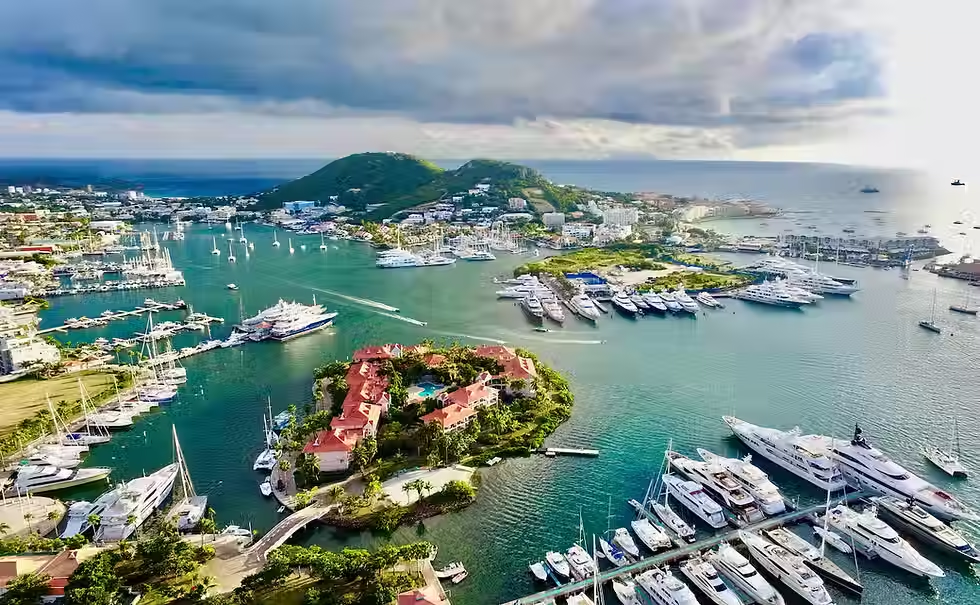
Day to day, the Simpson Bay Lagoon is a boating hub, Philipsburg is the Dutch side's capital and cruise port, and Marigot has its market and waterfront. English is spoken everywhere, and French, Dutch and Spanish are widely heard.
What to weigh before you commit
We would not be doing our job if we skipped this part.
Hurricanes. The season runs from June 1 to November 30. Hurricane Irma, a Category 5 storm, hit the island in September 2017. The island has rebuilt and newer construction generally follows stronger codes, but ask how a building fared in 2017 and what was redone.
Running costs. Electricity and imported goods are expensive. Windstorm insurance deductibles are often a percentage of insured value.
Taxes. The island is not tax-free. Rental income is taxable, short-term rentals can carry turnover and room taxes, and your home country may tax you too. Get advice from a notary and a local tax adviser before you buy.
Title. On the Dutch side, some land is on long lease (erfpacht) rather than freehold. The notary will confirm which applies.
Questions we get
Can foreigners buy property in Sint Maarten? Yes. On the Dutch side there are no restrictions on foreign ownership. On the French side, foreign buyers purchase through a French notaire under French law.
Which side is better for rental income? Most short-term rental inventory sits on the Dutch side, in Simpson Bay, Maho and Cupecoy. The French side has strong villa demand in Terres Basses and Orient Bay. The right answer depends on the property, not the flag.
Is it expensive to live on the island? Some things are, especially electricity and imported food. Housing costs vary widely by area.
How do I start? Browse properties for sale, then talk to us. We are licensed on both sides.
Sources: Department of Statistics Sint Maarten (STAT), Q1 and H1 2026 releases, as reported by local press; airline and hotel announcements; St. Maarten Heineken Regatta organisers.
Ready to look at what is on the market? Browse our condos for sale in Sint Maarten and villas for sale in Sint Maarten, or see every property for sale.
More questions? Our Sint Maarten real estate FAQ answers the ones buyers and sellers ask most.


Comments